
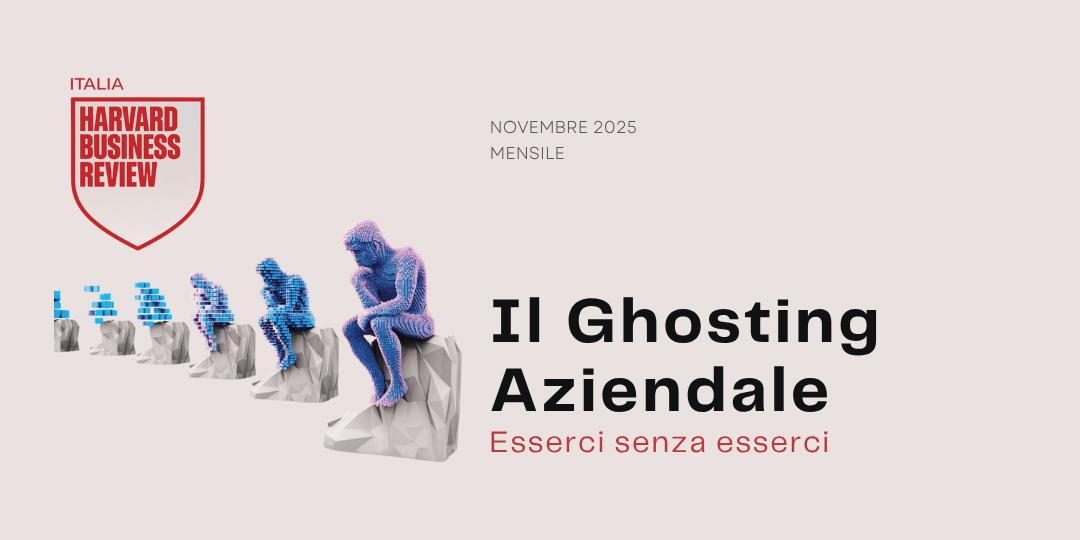
Diego Piovan, Managing Partner at Hermes Consulting & Giulia Terracciano, Work and Organisational Psychologist at Hermes Consulting, for Harvard Business Review Italia – Universo Consulenza
In many organisations today, we see a strange paradox: people show up, but they are not truly there. They attend meetings, answer emails, and meet deadlines, but the drive, engagement, and genuine motivation are missing.
It is a form of silent withdrawal that we call corporate ghosting.
It is not absenteeism. It is not negligence. It is not laziness. It is a reaction triggered when people can no longer find a clear link between what they do and what they believe in.
People stay, but they disconnect. This is not a generational whim: it is a systemic response, a warning sign.
Corporate ghosting is an umbrella concept: it encompasses quiet quitting, emotional withdrawal, and reduced mental effort. In neuropsychological terms, when an environment feels inconsistent or disconnected, the brain triggers a defensive response. The limbic system perceives a threat. The prefrontal cortex—the centre of motivation and planning—powers down. People are not withdrawing from work itself, but from the meaning that brought it to life.
They stay to avoid burning out, but they stop truly investing themselves.
According to the ADP Research Institute (2024), only 15% of Italian workers report feeling engaged at work. This phenomenon spans across the board: it affects every age and role; only the outward form changes.
We cannot explain ghosting through a linear cause-and-effect lens. We need a systemic perspective.
What happens on the surface reflects deeper, often invisible dynamics. Today, rapid technological evolution reshapes the competitive landscape. Organisations respond with new business models and reorganisations that create social and psychological instability.
Classical psychology, through Freud, identified three sources of suffering: our own body, the outside world, and our relationships with others.
Today, a fourth emerges: the sense that we no longer have any impact on our environment. A feeling of helplessness that leads straight to withdrawal.
Gregory Bateson, the anthropologist and systems theorist, used to say: “The relationship comes first”.
When people disconnect, it is because the bond between themselves and their context has grown barren.
This phenomenon surfaces above all during times of transformation that are not supported by realigning organisational culture: mergers, generational transitions, reorganisations, turnarounds, or the rollout of new technologies.
When change feels imposed, it creates distance. People stay, but they switch off. The issue is therefore neither structural nor motivational: it is relational and cultural.
It comes down to leadership’s ability to recognise and hold space for emotions during times of transition.
Corporate ghosting signals an internal disconnection that, if left unaddressed, undermines the organisation. Tackling ghosting does not mean pushing harder or communicating more; it is resolved through listening, engagement, and consistency.
Here are three tangible steps every leader can take:
Read the “silent” signals: drops in energy, lack of initiative, silence in meetings—these are not minor details, but crucial signals. Recognising them early allows you to act before emotional detachment becomes chronic.
Engage before, not after: every transformation must be built with people, rather than simply announced after the fact. Asking the right questions and listening with genuine interest builds shared meaning and trust.
Align culture and strategy: culture is not just a backdrop for business; it is its invisible engine. If it does not evolve alongside strategy, a gap opens up that hinders change and performance. It is therefore vital to guide the transformation of organisational culture, aligning it with strategic direction to support lasting shifts in behaviour and mindset across the organisation.
We need leadership capable of catching unease before it turns into withdrawal, and of rebuilding meaning at work through times of change. Losing motivation does not merely mean losing productivity. It risks switching off the very engine of the business.