INTRODUCTION
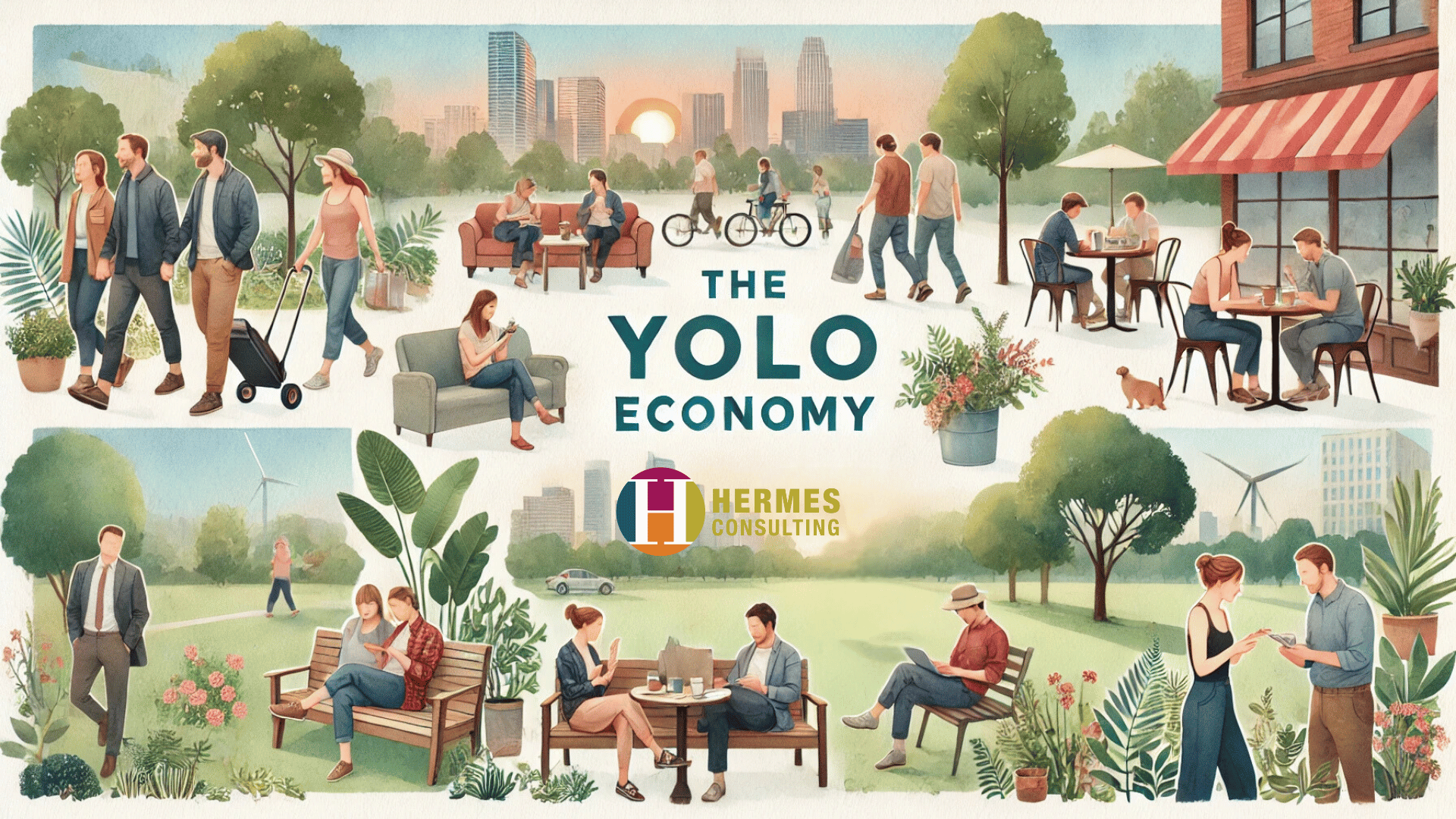
The emergence of the YOLO Economy – You Only Live Once – reflects a generational shift that places work-life balance at its core, prompting more and more people to seek authentic, meaningful work experiences. Over recent decades, the world of work has undergone a profound transformation. Where success and personal fulfilment were once tied to a stable career and total dedication to the organisation, today priorities have shifted fundamentally.
This phenomenon does not only concern younger generations: it also involves senior professionals who, after years of compromise, are reassessing their relationship with work.
The pandemic amplified the desire to live life to the fullest, raising new questions: how can we strike a balance between ambition and well-being?
How can work adapt to people’s values and aspirations, rather than stifling them?
Today more than ever, organisations are called upon to rethink their attraction and retention strategies, looking beyond generational divides to build an organisational culture that meets everyone’s needs.
The Evolution of Work: From Total Devotion to Desired Balance
Until a few decades ago, a career represented one of the primary sources of personal fulfilment.
The prevailing view was that success was measured by total dedication to the company, marked by exhausting hours and relentless sacrifices. Family was often placed second, because work was seen as the core pillar of adult life.
During the economic boom, work was associated with stability and financial security: building a career meant ensuring your family’s prosperity and achieving recognised social standing.
In that context, personal identity was closely intertwined with one’s professional role.
“What do you do for a living?” was not merely small talk, but a defining badge of identity.
However, as society evolved and technological changes gathered pace, perspectives on work underwent a radical transformation.
Rising generations began to reject the idea of sacrificing their personal lives for their careers. The COVID-19 pandemic further accelerated this shift, as people began reflecting on the true value of time and health.
Work is no longer seen as an absolute priority, but as one part of a richer, more meaningful life.
These questions arise naturally: how can we balance the desire for success with the need to live a full life? And above all, what truly matters today to feel fulfilled?
The YOLO Economy: When and Where Work Meets Life
In recent years, the YOLO Economy has captured attention as a phenomenon associated with young people who, mindful of an uncertain future, choose to live fully in the present.
While this trend has gained momentum recently, its roots lie in a deeper transformation that has swept through the workplace over recent decades. Digitalisation and increasing job insecurity have led people, particularly younger generations, to rethink the very concept of work.
It is no coincidence that the term began circulating widely during the pandemic, when people rediscovered the importance of living in the present and not putting off what truly matters.
The YOLO Economy can be seen worldwide, but particularly across Western countries, where younger generations have greater freedom to shape their own life paths.
The Great Resignation of 2021 in the United States is a clear example: millions of people left their jobs in search of better conditions, greater flexibility and meaningful impact. This trend is spreading across Europe too, where remote working and flexible work models are fast becoming the norm.
The Figures Driving this Revolution: Not Just Millennials and Gen Z
The protagonists of this revolution are not only Millennials and Generation Z; senior professionals are also embracing this philosophy, recognising
that it is no longer worth sacrificing health or happiness for work that brings no fulfilment.
The YOLO Economy is therefore a cross-generational phenomenon spanning people of all ages, united by the desire to live an authentic and meaningful life.
The significance of the YOLO Economy lies in its ability to reflect a profound cultural shift: people no longer want to wait for retirement to enjoy life.
They want balance right now; they want to feel recognised and valued at work, and they want their time to hold meaning. The YOLO Economy is the response to a world where old certainties have fallen away, leaving the present as the only certainty we have.
Organisations must rethink how they structure work and what they expect from their people.
Offering flexibility, supporting personal growth, and fostering an inclusive environment that respects individual needs is no longer an optional extra: it is essential to attract and retain top talent.
Work-Life Balance Is Now the Rule, Not the Exception
Research shows that work-life balance is not merely a preference of younger generations. According to a report by Forbes Italy (2023), around 70% of workers consider a healthy balance more important than salary. Nor does this apply only to those starting their careers: many senior employees, after years of compromise, are reassessing their approach to work. A survey by PwC (Global Workforce Survey) showed that 63% of employees aged between 45 and 60 prefer to avoid relocations or roles that compromise their quality of life. This shift in mindset proves that the need for balance is universal.
What does ensuring good work-life balance mean in practice?
It is not simply about having more free time, but about creating an environment where people feel supported, recognised and valued. Organisations that succeed in placing employee well-being at the heart of their policies achieve higher engagement and stronger talent retention.
Tangible examples include companies like Patagonia, which allows employees to contribute to environmental projects, and Google, which seeks to understand candidates’ deeper aspirations alongside their technical skills during the hiring process.
Are generations not often viewed as separate worlds, each with different needs and expectations? What if they are actually far more alike than we think?
At a time when generational differences are magnified by the media, the real cultural shift lies in recognising that everyone, regardless of age, wants to feel part of something meaningful. To attract and retain people across every generation, organisations must foster an inclusive culture that embraces diverse experiences and values every individual’s contribution.
Work should not be a place where we lose ourselves, but a setting that nurtures, enriches and contributes to shaping a shared future.
Organisations that understand this need and invest in building a flexible, human workplace are the ones that will thrive over the long term.
FURTHER READING:
WORK-LIFE BALANCE: FROM PARENTING TO CAREGIVING – NEW FRONTIERS IN CORPORATE WELFARE