
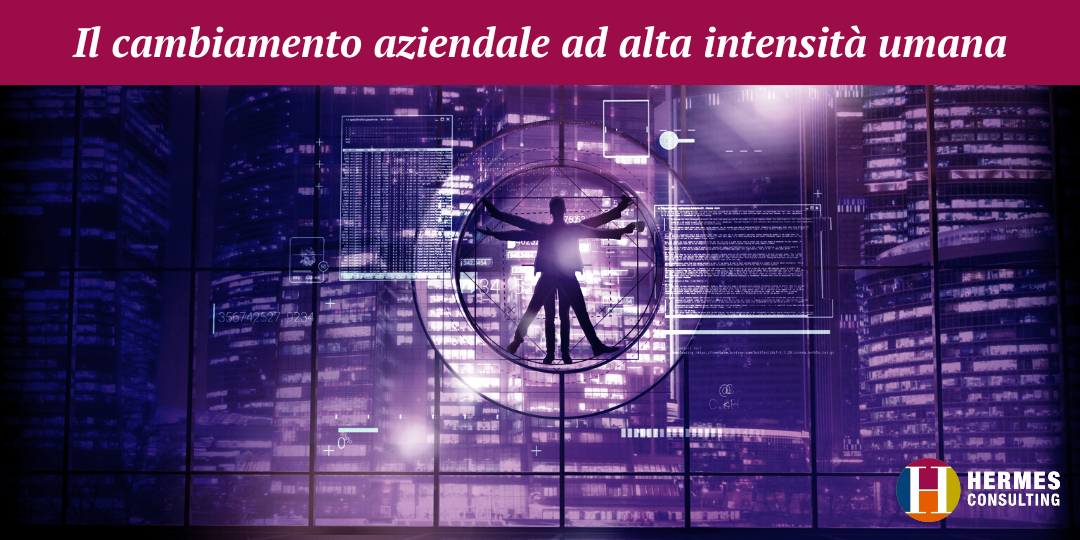
Driving change within an organisation requires understanding its deepest dimensions. When facing change, there is no room for improvisation. Instead, we must focus on the people actively shaping it—their needs, their soul, their personal experience, framed within the ecosystem that surrounds them.
We can view change as a prism emerging from multiple interconnected dimensions.
Hermes: the messenger of organisational change
For humanity, change is an age-old story. It has always been an inherent disposition, one that makes us human and truly alive. It has always resonated deeply within us.
Since antiquity, the philosophy of Heraclitus has taught us that “everything changes and nothing stands still“. Everything, even what appears most static, reveals itself from a broader perspective to be in continuous evolution—whether swift or gradual.
For the ancient Greeks, Hermes was the facilitator of transitions, exchanges, and passages. He embodied the journey from one place to another, from one state of being to the next. His nature was tied to the shifts in human affairs, to the exchange of information and trade. He was the god of communication, speed, agility, and adaptability.
All of these qualities are entirely relevant to today’s corporate world. Hermes embodies change within organisational systems, representing the ability to manage transformation swiftly and effectively, communicate with clarity and transparency to everyone involved, and adapt to emerging market needs and challenges.
Just as Hermes delivered the words and intentions of the gods to humanity, change within an organisation calls for a messenger capable of effectively communicating new objectives, challenges, and future strategies to all stakeholders—helping the organisation navigate forward with confidence and a message of trust and hope.
Change in organisations: a journey of renewal undertaken in stages
However, understanding the mythological dimension of change is not enough to act as an effective change agent within an organisation. Today, in an environment shaped by uncertainty and complexity, we must ask ourselves how we can truly drive change. To achieve this, a sound methodology is essential. As Kurt Lewin, one of the founding figures of social and organisational psychology, observed decades ago, organisations, much like living organisms, adapt to their environment, establishing a balance—a homeostasis—that naturally resists any disturbance that might disrupt it.
Change can therefore never happen overnight, like flicking a switch. To weave it into the fabric of the organisation and embed a new paradigm, a structured, phased process is essential.
First, we must unfreeze from the winter of a past paradigm that no longer fits, even if it feels familiar and secure. It requires a deliberate choice to shift norms and structures, generating shared motivation across the organisation to realign its core and let go of comfortable, well-rehearsed habits.
Next, the journey of change is designed, executed, and embraced, guided by a clear strategy and leadership that nurtures trust daily—ensuring the new ways of working take root and become as natural as the old ones.
Like a butterfly emerging from its chrysalis, transforming from caterpillar to winged creature, an organisation embracing change must be ready to leave old habits behind and evolve into something stronger and renewed. A butterfly’s metamorphosis takes time, dedication, and patience. In the same way, organisational change requires a gradual adaptation, where the business explores new ideas, strategies, and approaches. In both instances, transformation can be challenging and demanding, but ultimately leads to a new form of life—stronger and more inspiring than before.
The guiding star remains rooted in purpose—a purpose shared by the people who bring the organisation to life. The scale and financial impact of change, the roles of key players, the milestones, hurdles, and implications of transformation all require continuous stewardship. Kurt Lewin highlights that change management must unfold as a journey—a phased process opening up fresh perspectives for Human Resources. HR can heighten awareness around change and foster two-way dialogue between teams and executive leadership, strengthening mutual trust.
People at the heart of organisational change
Successful change management requires that each stage of this journey is carefully planned, that stakeholders communicate with transparency, and above all, that actions are people-centred—placing individuals and the human impact of change at the very core.
From an organic perspective, an organisation can be seen as a living entity, an interconnected cellular system.
Like a molecule undergoing a chemical reaction, change triggers a series of responses within people. It is therefore vital to understand the motivations, reasoning, and personal stories of everyone involved. Putting ourselves in another person’s shoes is essential to fostering shared empathy and developing an active listening mindset, allowing us to truly appreciate how others perceive the world.
No one changes alone. The true power of change emerges from our ability to connect with others—sensing their emotions and thoughts, understanding their feelings, while maintaining our own clear perspective.
Throughout this journey, the people within the organisation co-create a transformative path and work together to achieve the intended change. Each of us is an integral part of this process.
We are experiencing a cultural transformation—a new humanism that places people firmly at the centre of change.