How to use artistic metaphor to turn change into reality in business
Every great discovery we make is driven by an insatiable curiosity. This same curiosity has led Hermes to listen to many stories over its 25 years in business, with great admiration and passion. These are the many narratives that art shares with us, silently yet with profound power.
Through art, we can look towards tomorrow and explore all the possible shapes of the future, inspiring others and steering towards the best path forward.
Artistic metaphor allows us to see beyond current projections, opening our eyes to new ways of acting that we have never put into practice before.
Because art has an open code; it speaks straight to the heart before it is even “read”.
It allows us to begin from what people feel deep down, co-designing change strategies with them that are genuinely rooted in those feelings.
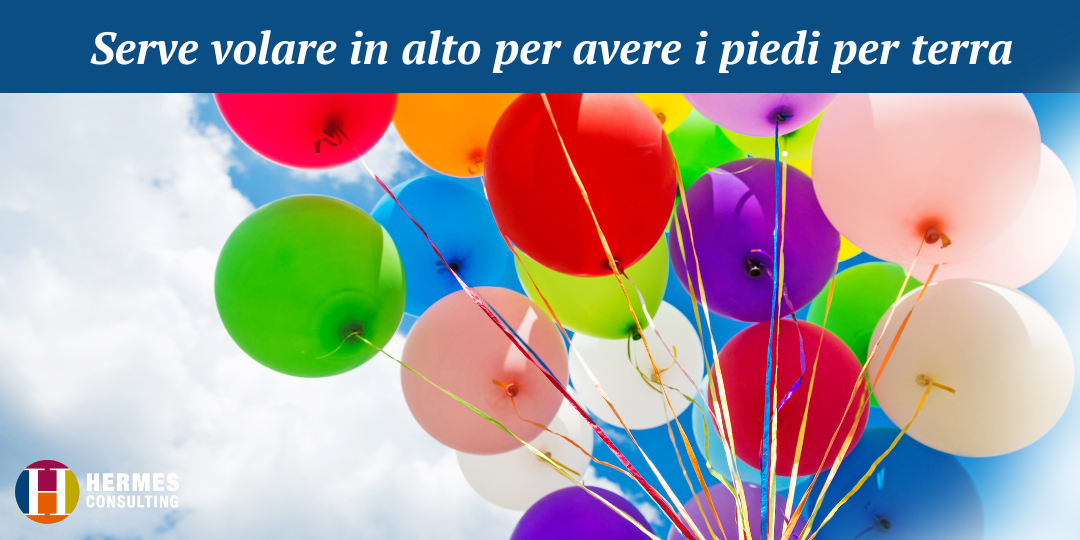
It might sound paradoxical, but for us, “you need to fly high to keep your feet on the ground”; because until the dream and desire rooted in our actions are rediscovered, the spark of change cannot ignite.
We have learned that the best, most successful projects are not just about meticulous planning and a well-structured approach; they are born from a dream and possess a palpable soul.
Artistic metaphor is our way of helping businesses read the future, inspiring them through powerful stories that speak to the value of unity and sharing, integrity and inclusion, justice and wisdom.
Why does art hold this power?
Everyone possesses inner resources waiting to be discovered and a self-regenerating potential waiting to be tapped. Art fulfills this purpose, allowing us to believe in the hidden abilities within each of us.
It can spark profound change, fostering self-awareness and unlocking potential from a developmental perspective. This power reveals itself most fully not in isolation, but when art is mediated by the presence of others—through dialogue and human connection.
It helps us give a clear identity to the challenges we face and express ourselves through a shared ground for dialogue.
Often, it enables us to view our difficulties differently, leading to an insight that brings us closer to overcoming obstacles.
Edith Kramer, artist and therapist, noted that “the work of art is a container for emotions”, while Vygotsky, one of the founding figures of psychology, spoke of creativity and imagination as essential elements for a better grasp of reality, sparking the search for new solutions and opening doors to change.
For us, art is not an escape from reality; on the contrary, it allows us to frame it and understand it more deeply, looking at it with fresh eyes. It also allows us to voice concepts that would otherwise remain unspoken and perhaps censored if we relied solely on verbal communication.
Art also speaks a language of its own—polysemic—that stirs deep processes and enables us to work on our present reality.
The creative dimension of a work of art helps us move past our blocks, bringing our lived experiences to the table alongside the emotional and cognitive elements that shape them.
Art for executive leadership
We guide business leaders through immersive experiences that bring them into direct contact with the history of art. We call these moments Outdoor Culturali®.
Here, executive leadership teams find the space to reflect deeply on themselves, their purpose, and the true reason for the organisation’s existence. They discover or rediscover the core values that serve as their guiding star and allow themselves to be inspired, coming together as Unica-Mente—cohesive, aligned and self-aware.
Sparked by artistic metaphors, leadership teams:
- reflect on their own dynamics
- find common ground and move past conflict
- step back from behaviours that hinder genuine, sustainable transformation and change.
This approach harnesses the isomorphism between the organisation’s experience and the artistic representation, opening new windows of perspective and enabling faster shifts in thinking. People gain a clearer awareness of who they are, how they act, and where they want to go.
That is why, over the years, we have continued to design programmes within artistic settings, offering businesses experiences that are both isomorphic and regenerative:
- Isomorphic, because, as Gestalt psychology posits, “there can be structural identity between experiences and the underlying physiological processes”. Looking at a work of art, people can genuinely see themselves in the story and feel part of it.
- Regenerative, because they open doors and windows where everyone can find their place, sparking extraordinary leaps of intuition.
At Hermes, art is the starting point for work that encourages dialogue and open exchange, building a shared vision around the matter at hand.
It provides a space where colleagues who have worked together for a long time can engage in an emotionally resonant experience, where the team itself steps up and explores its internal dynamics.
Because it is vital to “see and feel” the outcome you want to achieve, and art, imagery, and emotion help us turn that vision into reality.
To learn more about our Outdoor Culturali® and discover how we work with artistic metaphors, click here.