Covid-19 is actually an interesting virus.
All viruses, in their simplicity, need to mutate continuously in their outer lipoglycoprotein shell to ensure survival, and our COVID-19 is no exception. In fact, more than others, it shows itself to be very confident with change. What mutates is its deep structure – what is technically known as RNA – and consequently its surface structure.
Its behavioural pattern therefore shifts, in the frantic race for life that is secured through contact, connection and interrelation with another living being.
Covid-19’s distinctive capability thus lies in its remarkable flexibility and ability to change in response to the altered characteristics of the environment it interacts with.
From the visuals we see, this virus also reflects a very contemporary aesthetic… it is striking in design and colour, as if crafted by an innovative jewellery designer, ready to become a bold icon of the fashion business.
A real and regal virus, then, commanding our daily attention, guiding and steering our present actions and our reflections on the future, expressing its strength in the awareness of its own uncertainty and the necessity to mutate to survive.
It is striking how the biological dimensions of the virus mirror, in some ways, the human experiences we are feeling inside and outside ourselves in these times; and it would be equally striking to observe how, through closer exploration, insights and strategies can emerge to help us navigate this singular moment.
I refer, specifically, to the concepts of fragility, uncertainty and dependence, but also to those of recentring, opportunity and connection.
We are afraid: afraid for our health and that of others, afraid of losing the points of certainty, serenity and stability upon which we built our personal and professional lives.
We are disorientated, all of us and at every level, and amidst this disorientation we try to find answers in what is familiar and known, or we wait for someone to provide them.
We are held in a strange isolation, which we endure as if forced to quarry stone from a mine, overwhelmed by a digital wave that invades our time and space and that we are struggling to ride.
Yet if all this is real, there is also something else we risk missing.
In this acrobatic display of volatility, what can we rely on?
Amidst absolute uncertainty, what are the certainties of these extraordinary times?
- It is a time for equality: the feelings and thoughts moving through us are the same for everyone. Never have we felt so similar and, in that similarity, supportive and connected. The pandemic is an equaliser.
- It is a time for action: in being practically engaged, we somehow find meaning and direction. We live in continuous learning, in active experimentation.
The pandemic “augments” us. - It is a time for common sense: we find ourselves reconsidering our primary needs, reassessing what we took for granted. Re-evaluating weights and measures. Returning to basics, to the essential, we reset our priorities.
The pandemic flattens Maslow’s pyramid. - It is a time for authenticity: in a crisis, the deepest principles guiding us emerge with force. People reveal themselves in their truest light, and this, beyond good and evil, clarifies and guides. It is a time for taking stock, for a conscious reading of ourselves and others.
The pandemic qualifies. - It is a time for sensory awareness: the availability of suspended time, slowness, the absence of contact and movement are sharpening our sensory receptivity. Our perception of the outside and inside is heightened. We are in a time of listening.
The pandemic amplifies.
Yet the greatest certainty is that we will get used to uncertainty.
We are creatures of habit and adaptation; time will help us clarify the new boundaries of the playing field, codify the new rules, and equip ourselves with fresh capabilities and skills to reorient ourselves within the new landscape and make it more familiar and workable.
Narrowing our focus, how does this collective sentiment impact professional systems? What is happening instead to organisations, to those with leadership and governance responsibilities, to people and teams? What are their reactions? What are their needs?
Here too, the certainty is that the present is already the future; clarity about what lies ahead will be built day by day. Predictability is a rather fragile option.
Past paradigms will likely no longer work; we will need to rethink business models, service models, the familiar touchpoints, and consequently review capability frameworks and, no less importantly, redefine the boundaries and content of the role of leaders.
Leaders are among the primary targets of the disruption caused by this regal virus.
Disorientation among leaders naturally takes every conceivable form: anxiety over control, paralysis and absence, forced cheer and team cheerleading, creative hyperactivism, watchful waiting, lucid focus, and so on.
Attempting to craft a solution that immunises our leaders from the perils of uncertainty is practically utopian, just as imagining off-the-shelf strategic and organisational solutions that apply indiscriminately to every context would be.
Reflecting on the leadership of the future must therefore be approached by looking at the uniqueness of each organisational context through fresh lenses, taking into account the impact of new variables (contact vs distance, digital tools, etc.) on key business dimensions (such as relationship dynamics and value propositions).
Certainly, there is clear evidence that effectively guides immediate action: learning to manage the impact of digital ways of working and remote work, reshaping professional relationships at a distance, managing emotional states, and redesigning operating models to ensure sustainability and survival.
Once this is done, it will be crucial for leaders to develop more conscious perspectives on the issues raised by our current reality, building the resilience needed to support the reconfiguration and effectiveness of their role in the near future.
From now on, leaders will play their game around the theme of trust:
in a future that will be, if not entirely contactless, certainly differently connected, we will need to rethink the concept of trust, updating its meaning and its impact on business strategies and professional relationship networks.
Leadership is therefore increasingly emerging as a situational and hybrid practice that embraces and accommodates uncertainty, has grown familiar with volatile times, and flexes around key milestones born from recent events:
- building relationships of trust based on credibility—that is, on recognised competence and reliability. A leader is credible when demonstrating a clear understanding of the risks and consequences of situations, using this insight to guide decisions;
- acting with transparency: a concept closely tied to trust. Today more than ever, this means providing objective, highly specific and detailed information. Grounding communication in reality while avoiding ambiguity meant to sugarcoat the pill;
- valuing and integrating differences within the team. In times of uncertainty, a diversity of skills and capabilities increases the chances of finding effective solutions to overcome systemic challenges;
- backing the “mismatchers”: systematically welcoming critique as an integral part of decision-making strategy. Moving beyond the ego-comfort of yes-men and courageously opening up to questioning one’s own ideas and beliefs, turning challenge into a source of value, enrichment and validation;
- nurturing restlessness or supporting the “restless”—those in the team who naturally tend to challenge the status quo with a drive to rewrite the rules. “The restless are precisely those who strike the right chord, yet struggle to be effective because existing corporate systems are so often defensive” — E. Capellino, Head of C.S. CNH Industrial;
- building connections: the era of solo stage performers, hyper-inflated egos, and insular cliques is over. The ability to stay connected will be decisive for future success, as Rüdiger Fox, CEO of Sympatex, notes: “We need to learn to support each other, because we are now deeply interconnected and therefore directly or indirectly dependent on one another. If we continue to focus on maximising our short-term interests, we will be left alone in the next crisis. And we should start right here, with our employees.”;
- rebuilding from the foundations: letting go of overcomplicated systems and starting again from what is essential; the prerequisite here is the ability to recognise and isolate within simplicity what truly matters: the essence.
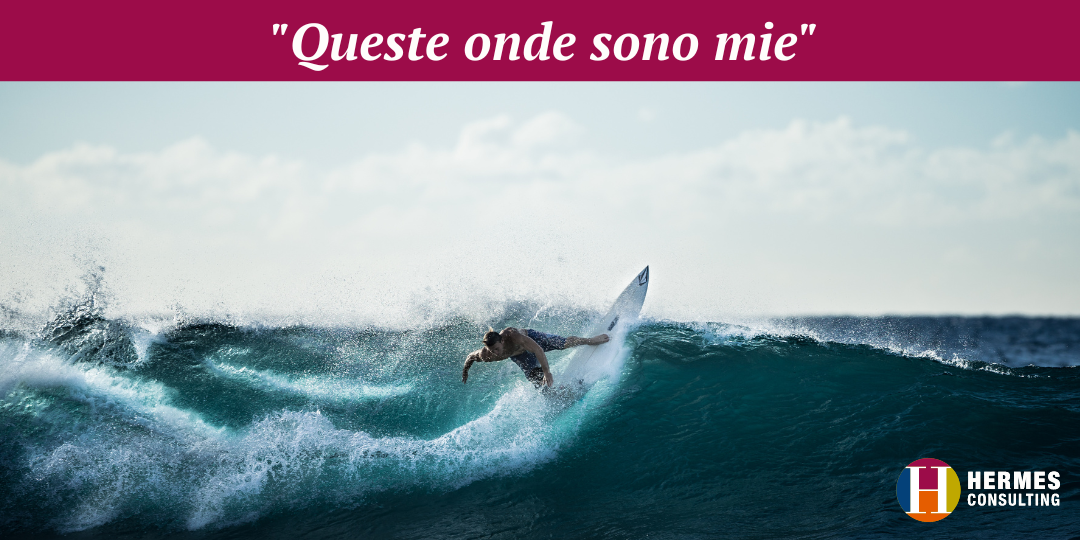
In the viral spread of this era, we need trust; we need to remain interconnected; we need to become skilled at responsiveness, staying flexible and swift; we need to be competent; we need to learn how to create breathing space through actions and behaviours that reflect who we are; and above all, we need to learn to ride the wave, because we all know that this is where we will be for a while, whether as individuals or as leaders.
Thank you, Mr Covid-19.
Written by:
Marinella Pulvirenti
Senior Consultant at Hermes Consulting