INTRODUCTION
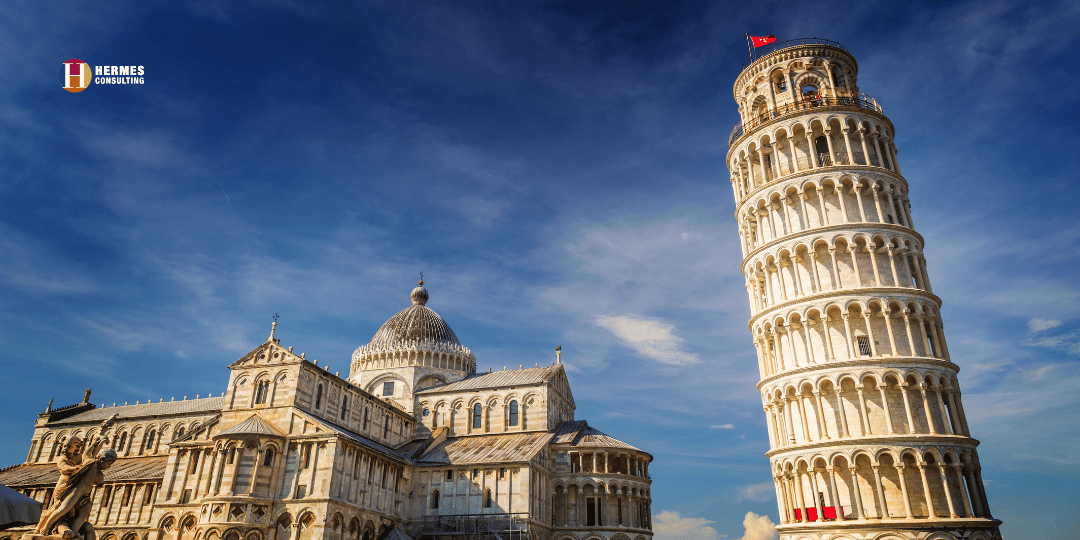
We are in Piazza dei Miracoli, in front of the Leaning Tower of Pisa, where people from all over the world reach their hands out into thin air to be photographed in an iconic pose: the tower behind them, bodies leaning, mimicking an attempt to straighten its tilt.
Seen from the outside, the scene can look almost comical. After all, we are watching people holding their arms out towards nothing. Yet, that photograph captures something profoundly human: whenever we see a leaning structure, our instinctive reaction is to try and steady it, even if only symbolically.
The scene reveals something else, too. Faced with the very same Tower, people adopt different postures. Some strike a pose immediately, some look for the perfect angle, some exaggerate the gesture, some watch from a distance, some join in with humour, and others remain on the sidelines. The structure is identical, but the way people position themselves before it changes.
This dynamic mirrors what we encountered during a programme launched with a multinational client, who asked us to guide a group of assistants in using artificial intelligence in their daily work.
The initial request seemed focused entirely on tools. From the very first conversations, however, it became clear that the challenge was not purely technical. Initial interviews revealed a varied picture: some individuals were using AI extensively, with curiosity and experimentation, whilst others relied on it almost exclusively to draft or rewrite emails. Tools, frequency of use, levels of trust and willingness to delegate varied widely.
We were facing a group with markedly different postures towards the very same object.
How we worked
For this reason, the first session was not designed as a technical training, but rather as an exercise in reading the context.
Before talking about tools, we needed to understand the perspective from which people were viewing AI and the foundation upon which their usage was developing.
We worked across three stages:
- Preliminary listening
An initial round of interviews helped us identify existing practices. - Rapid pulse survey at kickoff
We used short surveys to map a clear picture of the group. The questions explored: when AI is used, for which tasks, how often, when it is not considered useful, what risks are perceived, what would never be delegated, which tools have already become part of daily routines, and how individuals describe their own attitude towards these systems. - Debrief and guided reflection
Drawing on these findings, we built a debrief designed to assess not only the adoption rate, but also the kind of relationship already established with AI.
This phase served a clear purpose: not just measuring adoption, but understanding the ground beneath it.
Why the Leaning Tower of Pisa?
It was through this work that the parallel with the Leaning Tower of Pisa came into focus. Not simply because of its fame, but because its story immediately redirects attention to what truly matters.
The problem with the Tower of Pisa has never been the tower itself; it has always been the ground.
The Tower was conceived as the bell tower for the cathedral within the monumental complex of Piazza dei Miracoli. It was never intended to lean: it was designed to stand upright, stable, aligned with the original blueprint. The tilt appeared almost immediately, revealing the fragility of the soil, which was too soft and unstable to support it as planned.
From that point onwards, every intervention had to reckon with this initial condition.
The 4 lessons from the Leaning Tower of Pisa
The Leaning Tower of Pisa serves as an effective metaphor for artificial intelligence because it demonstrates that even a system built with clear intent and tremendous potential can quickly tilt if it is not supported by the right conditions.
The Tower was not built to lean. The tilt was never part of the plan. It emerged during construction as the ground gave way. The builders attempted to compensate for the flaw as they continued to build upward. As a result, the tower is not merely leaning: it is also slightly curved. Growth, however, does not erase an initial flaw. It incorporates it.
Applied to AI, the metaphor becomes striking. Artificial intelligence can appear powerful, swift and masterfully engineered. Yet if it rests on poor data, vague prompts, ill-defined objectives, weak governance or uncritical usage, the tilt will quickly emerge. And the issue does not always lie within the algorithm. Often, it stems from how the tool is introduced, prompted and governed.
The Leaning Tower of Pisa offers at least four lessons.
First: a promising system can be built on fragile foundations.
Second: growth does not automatically correct initial errors; it can amplify them.
Third: pausing is not a failure; pauses allow us to settle, verify and adjust.
Fourth: not everything imperfect must be discarded; sometimes, it must be governed.
Indeed, the Leaning Tower of Pisa was never fully straightened; it was stabilised while honouring its history. AI should not be regarded as a flawless or self-sufficient tool, but as a system that requires guidance, oversight and grounding.
Why this metaphor resonated
Within the group we were supporting, this reality was evident. Differences among participants were not merely about technical familiarity with AI, but about their starting point. Some had already established an active relationship with the tool, others viewed it as an incidental aid, whilst others navigated between practical utility and caution.
In every case, however, the same underlying challenge emerged: AI mirrors and amplifies the way it is engaged. A generic prompt usually yields a generic answer, however articulate it may seem. A weak context is not automatically reconstructed in a reliable way. Without clear evaluation criteria, the output may appear polished yet remain fundamentally flawed.
This is why the core challenge is not simply learning to use AI. The challenge is learning to guide it.
The capability to cultivate
This insight brought the programme’s objective into sharp focus. It was not merely about increasing familiarity with a tool, but about developing a vital capability: the ability to direct and guide it.
For professionals with a strong focus on execution, this shift is significant. It means:
- moving from performing a task well to setting up the right conditions for it
- framing clearer requests, providing context, defining explicit criteria and identifying the limits of the output
- deciding what to delegate and what to oversee directly.
In this light, communication is no longer just an expressive skill. It becomes an intentional act of delegation.
Guiding AI means precisely this: creating the conditions that make the output useful, coherent and verifiable. It means knowing when to accelerate, when to course-correct, when to pause, and when human oversight must remain firmly in place.
Conclusion
The Leaning Tower of Pisa remains a powerful metaphor because it shifts our gaze from the fascination of the structure to the quality of oversight that keeps it standing.
When we address artificial intelligence in organisations, the question is not merely what the technology can do. The real question is how we prompt it, towards what goals, with what context, through which verification standards, and with what level of human responsibility.
A structure can be prominent, useful and widely admired, yet still remain fragile if left unmanaged.
True innovation does not rely solely on the sophistication of technology, but on the ability of people and organisations to give it direction.
Further reading:
Digital transformation: it is not a matter of timing, but of making it truly happen