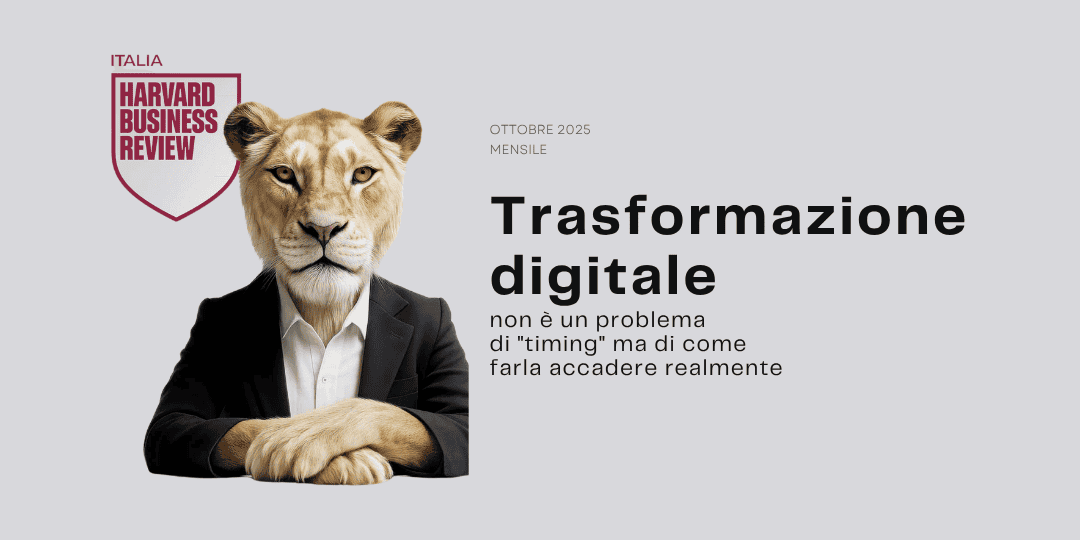
Diego Piovan, Managing Partner at Hermes Consulting, and Angela Turturro, Client Manager at Hermes Consulting for the Harvard Business Review Italia editorial
New languages, platforms and increasingly sophisticated tools are driving organisations towards rapid innovation programmes. People are being asked to adapt, train, and change.
It is a relentless race, but at times it feels as though there is no clear finish line to cross.
It is worth pausing to ask ourselves: will this race truly generate a different way of working? Will the initial design be fulfilled? Will the results be visible?
If the answer were yes, the effects would already be apparent. Instead, the data tells a different story: 92% of companies have invested in AI, but only 1% consider themselves capable of integrating technology and culture in a generative way (McKinsey, 2025).
The rest have stalled at a critical juncture: between the desire to innovate and the ability to make change real. This is not a technical issue; it is a cultural one.
In our experience at Hermes Consulting, we have seen this happen for thirty years: systems evolve, but people often do not feel part of the process, and the transformation grinds to a halt.
We supported the leadership team of a major company that had invested heavily in a digitalisation project: upgraded technologies, internal training, redesigned processes. Yet, after a few months, adoption was low, enthusiasm had waned, and people felt disoriented.
Our starting point was listening. Not as a formal step, but as an intentional, widespread act. We asked people to tell us what they were experiencing, where they encountered obstacles, and what they perceived as a resource or a burden.
A clear divide emerged between strategic ambition and daily reality: a lack of meaning, mistrust, unspoken resistance, and intergenerational misunderstandings.
At that point, it became clear: a different kind of intervention was needed. Deep work to realign what the organisation wanted to become with what people were experiencing every day.
We therefore designed a support programme for the digital transformation, tailored to the leadership team, guided by our
proprietary methodology IRiS – Regenerative Strategy Implementation, structured across three integrated levels:
- Intergenerational Action Labs: we formed cross-generational groups to tackle real challenges, not abstract exercises. The goal was not to find the “perfect solution”, but to build alliances between different perspectives. Rising generations brought vision and agility. Senior members offered context and a sense of sustainability. Change took root in mutual recognition, when people stopped defending their own viewpoint and began building together.
- Mindset & Skills Labs: in parallel, we ran programmes to develop deep listening, the ability to read relational dynamics, and the skill to act beyond role boundaries. These are essential capabilities for navigating change, because it is through the quality of presence, clarity of intention, and consistency between what is said and what is done that the system can move in the same direction.
- Narrative Sharing: finally, we created space for an authentic account of the change: not simply presenting results, but sharing the steps, doubts, mistakes, and shifted perspectives along the way. Many initial barriers dissolved right there, in the simple, candid stories of those who lived through the process from the inside.
We need to create the conditions that enable people to see themselves in the change, contribute their ideas, and embrace it as a shared challenge.
Transformation happens when the way we work changes: through new behaviours and a new mindset across the organisation.
diego.piovan@hermesconsulting.com
angela.turturro@hermesconsulting.com
Read the article on Harvard Business Review: https://digital.hbritalia.it/harvardbusinessreview/newsstand