
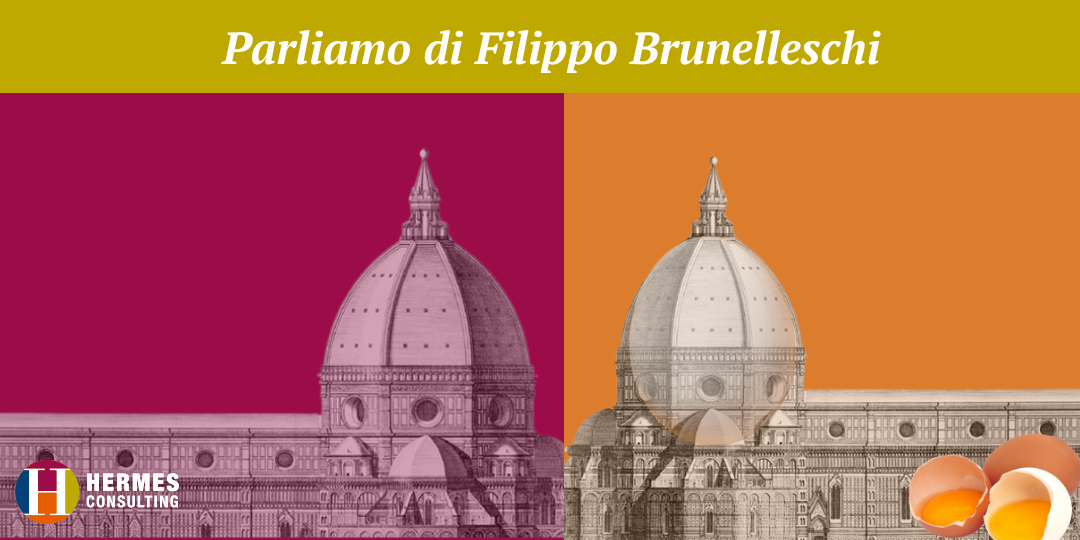
You certainly know the magnificent cathedral of Santa Maria del Fiore in Florence, and you have likely been captivated by the majesty of Brunelleschi’s Dome.
Yet are you familiar with all the innovative solutions and remarkable practices this great man introduced to achieve the magnificent result we all admire today?
Did you know that Filippo di Ser Brunellesco Lapi, better known as Brunelleschi, was the first to set up a canteen for his workforce? He created it directly inside Florence Cathedral.
He was undoubtedly the only person in the 15th century capable of opening a restaurant more than 114 metres up in the air, connecting a purpose-built kitchen to scaffolding and hoisting equipment that could transport food directly to where the craftsmen were working, saving them the climb down to the ground.
He even built masonry latrines, in an era when sewers were the exception rather than the rule.
Where did these ideas come from?
Brunelleschi was guided by strong values, which he used to make decisions with consistency and responsibility. Yet he had also embraced a grand vision and succeeded in expressing it masterfully, moving from the macro perspective down to the finest detail.
Brunelleschi’s vision placed human beings at the centre, literally: man as the measure of all things.
He lived in an era when mathematics and the humanities were intimately intertwined, harnessing geometric harmony to elevate human dignity through art.
Let us take a step back, however, to retrace his story together.
Brunelleschi: the story of a genius
Did you know that he was, first and foremost, a goldsmith and a sculptor? To be precise, he was a goldsmith who went down in history as the first true architect.
He applied a goldsmith’s meticulous attention to the smallest details to construct monumental, awe-inspiring architecture that remains unmatched to this day.
He possessed the extraordinary gift of representing reality with scientific rigour, coupled with a deep desire to generate harmony that was both visible and tangible. His architecture is akin to solid melody, whose notes are grounded in human proportions.
Filippo was the first to share with his team the information required to build an edifice. Even before that, he imparted a vision to them, enabling them to solve autonomously the challenges that inevitably arise between design and execution on site.
Furthermore, he pioneered linear perspective, which would underpin Florentine Renaissance art: a groundbreaking invention designed to depict reality in all its dimensions.
What makes Brunelleschi significant
It is said that the artist managed to construct the dome of Florence Cathedral starting from a deeply shared vision that was not originally his own. As early as 1294, the dome had been depicted in Bonaiuti’s frescoes in the Spanish Chapel at Santa Maria Novella. Yet two centuries later, the project remained merely a dream. Filippo Brunelleschi had the courage to pursue that dream and turn it into reality, exploring every field of contemporary knowledge and seeking practical, effective tools to accomplish the feat.
His capabilities extended far beyond engineering and technique; in fact, relationships were his most essential tool in delivering the project.
The power of relationships
- He had to build an effective relationship with the patrons, understanding their genuine requirements, addressing their doubts and their fear of novelty, and finding the best way to convey his vision—or rather, the project he envisioned. Legend has it that he used an egg to illustrate his concept, cracking it in half to clearly demonstrate the dome’s shape and structure, effectively proving how the building would stand. He used miniatures, diverse objects, and illuminating metaphors to help people truly see.
- Equally, his relationship with his team was managed with exceptional care: he demonstrated how to construct and handle tools by working with them himself alongside the craftsmen, leading by example. He crafted prototypes carved out of fruit and vegetables. He empowered his workforce, giving them the autonomy to propose solutions that were even more functional than his own.
Finally, he optimised the use of available materials, preventing waste and ensuring every component was placed in the most functional position to support not just the dome, but the shared vision and purpose.
Filippo Brunelleschi elevated people 114 metres into the sky, allowing them to look upon the world so that, once back on the ground, they could adopt new behaviours with renewed awareness. He created an achievement that was not merely artistic and architectural, but civic: visible from countless viewpoints across Florence, inviting anyone who looked up to elevate themselves.
Change leadership and the artistic metaphor: what can Brunelleschi teach us?
- SHARED VISION AND PURPOSE FORM THE BEDROCK OF ANY VENTURE
While Bonaiuti, the first to depict the dome visually, embodies the metaphor of visionary thinking, Filippo Brunelleschi demonstrates that Vision and Purpose only become reality through deliberate actions aimed at execution. Moreover, without a rigorous analysis of the context and the resources needed to achieve the goal, vision remains an end in itself. Brunelleschi first aligned deeply with this vision, then successfully conveyed it to others, engaging in dialogue with those whose contributions were vital to its realisation.
- THE ABILITY TO SEE BEYOND
He possessed clarity regarding his goals, but more importantly, he could see the whole picture, perceiving the finished puzzle while looking at individual pieces. He understood his context thoroughly and envisioned the final result in his mind’s eye long before construction began. To deliver such an ambitious endeavour, Brunelleschi had to expand perspectives—beginning with his own and extending to others through generative dialogue.
-
EFFECTIVE COMMUNICATION
He was skilled at communicating, engaging people, and conveying what he intended to build. He did so by setting an example, using tailored metaphors, and presenting tangible objects that gave shape to his ideas. At the same time, he remained open to discussion and dialogue, viewing other people’s contributions as valuable learning opportunities.
- SYSTEMIC THINKING AND PUTTING PEOPLE FIRST
The architect took personal accountability for the outcome of his work. Drawing on his ability to work with a systemic perspective, he considered the project in its full complexity and entirety. This led him to design a canteen, a kitchen, and latrines directly on the building site. To construct the Cathedral, he attended to the needs of every individual, ensuring everyone could perform at their best. Human beings remained at the centre—the fundamental measure of all his work. Filippo Brunelleschi consistently showed great trust in his people and committed to building an environment where individuals genuinely felt a sense of belonging.
Brunelleschi’s legacy for us at Hermes Consulting
At Hermes, we look to Ser Filippo Brunelleschi as a guide and a virtuous model of leadership. For this reason, we share his story and bring leadership teams before his works to:
- Reflect on leadership roles and the capabilities required to guide a team
- Foster participatory leadership rooted in listening, support, development, and constructive dialogue
- Learn how to communicate effectively and nurture generative relationships with team members
- Explore the skills of an effective leader, putting them into practice to optimise people management
- Cultivate awareness, alongside the knowledge and skills needed to navigate key conversations with colleagues
- Broaden perspectives towards continuous learning and growth, while refining goal management
- Follow in the artist’s footsteps to deliver a shared vision; because relationships are the true space where leadership happens
Filippo di Ser Brunellesco Lapi at the heart of our Outdoor Culturale®
Filippo Brunelleschi’s example invites profound reflection on the complexities of leadership and the vital importance of the relationship with one’s team.
Hermes shares his journey within an Outdoor Culturale®, harnessing the narrative behind the dome as a powerful catalyst to unlock personal energy, potential, and resources.
Through art, this approach engages the emotional dimension of the mind, rekindling motivation and proactivity while stimulating rational, critical thinking. As a result, it accelerates tangible results.
It is a growth and learning experience mediated by the language of art, experienced firsthand in the very setting where the masterpiece stands.
This type of Outdoor programme helps us explore key questions, including:
- How can we act as leaders of change?
- How can we communicate effectively?
- How can we achieve our goals while nurturing relationships with all stakeholders?
Furthermore, exploring the journey behind this “impossible” architectural feat allows us to develop new ways of thinking, cultivating a problem-solving culture to manage complexity effectively.
Brunelleschi taught us timeless lessons six centuries ago. Above all, he demonstrated that a monumental achievement, like Santa Maria del Fiore, cannot be realised without putting people at the centre.
To learn more about our Outdoor Culturale® programmes, click here.