Where are we heading, and what kind of present allows us to envision the future?
Twenty years ago, the acronym VUCA was coined to describe our contemporary world as VOLATILE, UNCERTAIN, COMPLEX, and AMBIGUOUS.
This is a world that calls for a different kind of thinking and a new mindset. No longer a world where finding the answers is what matters, but one where asking the right questions is essential.
We are used to approaching “problem-solving” in terms of measurable, predictable phenomena; yet today we oscillate between two dimensions:
- A wealth of information and potentially infinite knowledge: best practices for virtually anything are at our fingertips.
- The awareness that there are no certainties: the validity of everything is provisional until the next, more updated and innovative discovery supersedes it.
Our scope of action, knowledge, and expertise has never been broader. The tools that enable us to measure and find answers have never been so accurate, yet ambiguity is palpable in everything we do, and the ultimate destination of every reflection is “complexity”. We can never stop exploring and experimenting. This environment challenges us every day, constantly prompting us to ask new questions and formulate hypotheses.
We are told that to look beyond the horizon, we must stop thinking in terms of statements; instead, we need to ask divergent questions that push our thinking that little bit further. We are encouraged to train our perception, so we can recognise patterns and distinguish signals from background noise.
Ultimately, we know that it makes no sense today to envision a single future, but rather to look at a range of different, equally possible scenarios. We can reframe, revisit, and take a fresh look at what is happening to make sense of it.
Working on the future means exploring possible, probable, plausible, and preferable scenarios. Each of them calls for distinct, specific skills and capabilities.
One of them, however, matters most of all: the one we choose.
We often picture tomorrow as a mere projection of today—our current reality squared. We add a few incremental elements to what we already know, and a new picture takes shape. We might call it “the official future”: institutionalised, pursued through a precise plan designed to minimise variance.
Yet there is a question we perhaps do not ask ourselves often enough: if we picture ourselves five years from now, who do we want to be? What do we envision becoming? And what do we not want to see in the mirror?
THE FUTURE WE CHOOSE
There is no need to point out that we are in the midst of a storm. Today, at least five different generations are active in public life, and all of them, in their own way, agree that our current environment has “blurred boundaries”. So, when we find ourselves in a storm, losing our bearings, without a clear map to guide us—what do we look to?
An old mariner would surely answer: “the stars”.
A desirable future does not reward the illusion of certainty; it cannot be reached if we assume we know everything and have everything under control. Foresight is certainly essential, but so is carrying a set of core values and principles that never fade, whatever the turbulence outside.
In a complex, crowded, and confusing present (and future), we can ask ourselves:
- What are our values?
- What are our beliefs?
- What are our needs?
- And above all, what are our purposes?
Working to share and align around these meanings makes us resilient to any crisis, because it ensures we always have a compass.
Someone once asked: “What happens when we walk towards the horizon?”
“We take five steps, and the horizon moves a little further away.”
“We take a hundred, but the horizon seems just as far.”
“We might want to grasp the sun, but in all its brilliance it remains out of reach.”
“So what is the point of heading towards the horizon?”
“It keeps us walking.”
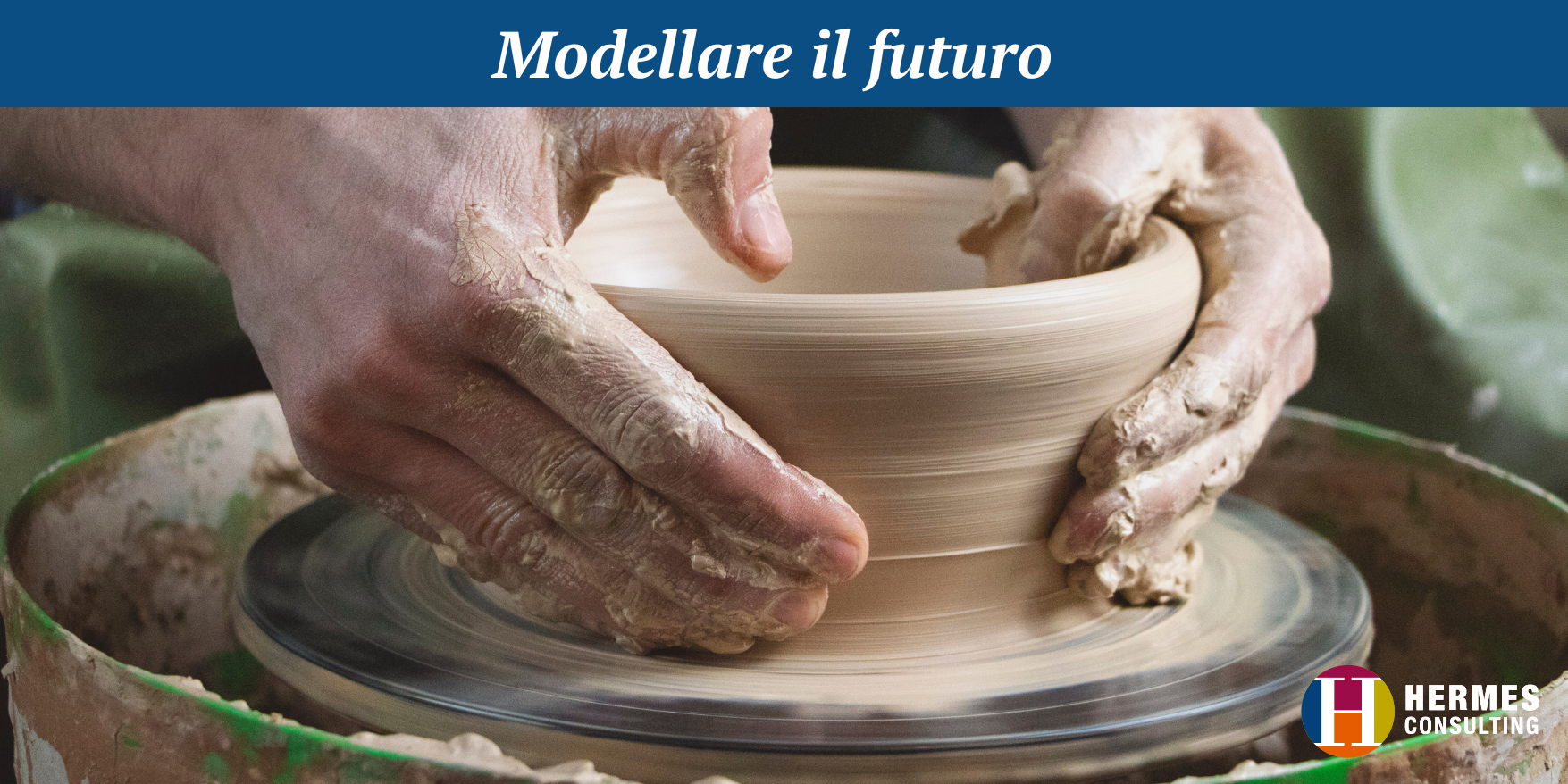
We can drift at the mercy of the waves and let the future decide for us, or we can choose to shape it. But we must hold the sculpture clearly in our mind, in our heart, in our eyes, and in the hands that strike the marble.
Stories hold immense power because they have a clear structure; they trace a journey, they carry meaningful messages.
There are three stories each of us should always carry within us to shape a future that is not merely anchored to reality, but closer to our dreams and our true, authentic aspirations.
WHERE DO WE WANT TO GO?
The first is a story about the future. We leap forward into tomorrow and imagine who we will be, what we will do. It is inevitably an evolving picture of what we want to become, but when we choose to articulate it, we generate the inspiration needed to achieve it.
It gives us the drive to keep moving forward:
- It has a positive impact
- It gives purpose to our actions
- It adds depth to what we do
What will our organisation look like one day? What story would we tell if we were to describe a typical day in that future?
This is a valuable tool for gaining clarity and articulating our intentions with purpose.
WHERE DO WE COME FROM?
Stories of the past are a constant guide; they help us find ourselves when we have lost our bearings.
It has often been shown that storytelling is therapeutic. It helps bring order to events, enables us to understand their impact on us, sometimes allows us to gain perspective, and above all connects every experience to where we stand today—weaving who we were and who we are into a single narrative. It also gives us the chance to make peace with some of our choices, to accept them, and to reflect on what the journey has taught us. It brings release, reconnection, and accountability.
A deep look at the past brings us back to the present with the energy to continue the journey, growing and improving along the way.
Why it matters:
- It helps us define our mission
- It connects who we are to something greater
- It grounds us in passion for what we do and keeps us motivated
WHAT DO WE BELIEVE IN?
Values remain mere words on a page until they are lived, shared, and even challenged. Yet they are our personal compass.
To bring them to life, it helps to delve into our own experience:
- When have I seen that value truly realised?
- When have I seen someone embody that value, and how was it put into action?
- When have I seen the opposite, and how did it make me feel?
The very same reflection applies to the organisation as a whole:
- What are we unwilling to compromise on?
- What is non-negotiable for us?
- What causes genuine frustration? What principle has been undermined?
To conclude, here is one final insight.
It turns out that the most effective way to shape the future is to visualise the fulfilment of our goals and aspirations in vivid detail, and then work backwards—identifying the steps that will take us where we want to go, right back to the present.
It frees us from the constraints of the immediate present and our daily routines, helping us write a better story.
The 17 Sustainable Development Goals of the UN 2030 Agenda were developed using precisely this approach, starting from the vision of a thriving planet.
Let us choose the same path toward a future of longevity and beauty.