
Do “Disney-esque” organisations really exist, where everyone’s contribution stems from shared passions and beliefs?
According to Simon Sinek, they do: they are the ones that build their culture and define their activity starting from why.
Do we know why we do what we do? Do we know why our organisation works on what it is working on?
BUT WHY?
Why was it Martin Luther King who created the civil rights movement? He was not the only man who suffered in an America of racial segregation, nor was he the greatest orator of all.
Why him, then?
Why were the Wright brothers able to make human flight possible? How did they manage to create the aeroplane, when others with more credentials and more money failed?
Something else plays a fundamental role, something that has nothing to do with the physical, tangible resources at our disposal.
A few years ago, Simon made a discovery that changed his view of how the world works and how best to take action.
There is a pattern, found across all great leaders and all organisations that inspire the world. They think, act and communicate in the same way, very differently from everyone else. All Simon did was codify it. Into a golden circle.
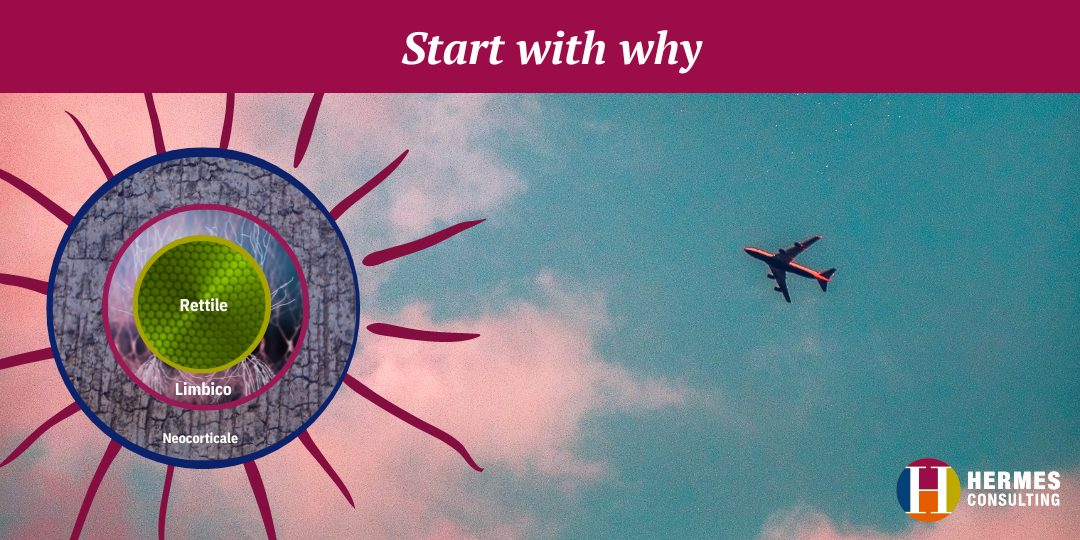
THE GOLDEN CIRCLE OF THE BRAIN SYSTEM
Credit: Simon Sinek. The Golden Circle
This circle explains why great leaders are able to inspire others.
Everyone in organisations knows what they do every day: 100% are informed. Very few know why, and “making a profit” is never the reason a business exists; profit is merely an outcome.
Why does the organisation exist? From what purpose was it born?
The most enduring organisations always have a clear answer, regardless of their size or sector, and they convey it to their users and their people.
Everyone else tells their story starting from the service they provide, because it is always tangible and obvious to their eyes.
Simply meeting a user’s needs with a service is not enough.
The highest, and most strategic, aspiration is to do business with people who believe what the organisation believes. This is the only true guarantee of stability.
A MATTER OF BRAIN BIOLOGY:
People don’t buy what you do; they buy why you do it
And this discovery is not a mere assumption, nor is it the result of psychological experiments. It is biology.
The human brain can be mapped into three parts:
- Neocortex
- Limbic brain
- Reptilian brain
The neocortex corresponds to the WHAT level. It is responsible for language and rational, analytical thought. Research confirms that in every marathon, it always crosses the finish line last.
The limbic system is responsible for emotions and much of our decision-making; it sits in the middle of the circle (HOW). It shapes our feelings and is deeply connected to the deepest, most primitive part of our brain: the reptilian brain.
It crosses the race’s finish line immediately.
The reptilian brain is directly responsible for our survival; it instinctively looks for reasons to determine whether it can trust or mistrust the other person (WHY).
Trust, loyalty, behaviour and decisions leave little room for words and bypass detailed information, because they all originate from the centre of this circle.
From outside in: from WHAT to WHY
When we communicate from the outside in, people can understand complex, detailed information regarding benefits, qualities, facts and figures, but this is not a powerful enough driver of behaviour.
From inside out: from WHY to WHAT
When we communicate from the inside of the circle outwards, we speak directly to the parts of the brain responsible for moving closer or pulling away, for instinctive behaviours, which people then rationalise with the additional, tangible information in the “WHAT”.
This is how most people make decisions.
The purely logical and rational “homo economicus” does not exist, as we have known for years.
All the information in the world does not foster connection. People might still say: “I know all the facts and details, but it still doesn’t feel like the right service for me; I’m not convinced.”
Why this feeling?
Because the part that truly controls decisions neither controls nor understands the language of detail. All decisions made from the “heart” or the “gut” happen at the centre of this circle. Information on the “What” then acts as the final accelerator.
At the heart of the decision
The goal should not simply be to find people who want what we have, but people who believe what we believe.
BRAIN SYSTEM: A QUESTION OF COMMITMENT
The same reasoning applies when recruiting staff or building any team. The point is not merely to select people who can do a job well, but to find those who choose to do it because they believe what the organisation believes.
If you recruit people simply for what they can do, they will work for a pay cheque. If you select them because they believe what you believe, they will work with passion.
The perfect illustration of this lies in the story of the Wright brothers.
At the turn of the 20th century, we find one of the most promising entrepreneurs of the era. He had just received 50,000 dollars from the War Department to develop a device that would allow humans to fly, chosen because of his exceptional Harvard credentials. So he hired the finest minds and built his team. Market conditions were excellent. The New York Times followed him to document every discovery. Everyone was rooting for him.
Yet why have we never heard of him?
Hundreds of miles away…
In Dayton, Ohio, Orville and Wilbur Wright had nothing that could be defined as a recipe for success: no major funds, no brilliant minds fresh out of college. They funded their projects with the proceeds from a bicycle shop.
Orville and Wilbur were driven by a powerful belief: if they could design and build this flying machine, it would change the course of the world. The New York Times favourite, by contrast, wanted to become rich and famous, but the goal had no deeper meaning for him than that.
The Wright team worked tirelessly, with passion, putting everything they had into it. The competing team worked merely for a generous pay cheque.
On 17 December 1903, the brothers took flight, and the world only found out a few days later.
I BELIEVE IN
In the summer of 1963, 250,000 people gathered in the same place to hear Martin Luther King speak, without a formal written invitation.
Dr King was not the only great orator in America. But he had a gift. He did not go around telling people what was needed to change America: he told people WHAT HE BELIEVED.
“I believe, I believe, I believe” and the people believed too. People took on his cause, made it their own, and shared it with others.
How many of the 250,000 people in front of him were there for him? ZERO. They were there to bear witness to what they believed for their America.
King said: “I have a dream.” He did not say “I have a plan.”
For Simon, those who truly lead inspire.
We follow those who lead, not because we have to, but because we want to.
WE FOLLOW THOSE WHO LEAD, NOT FOR THEM, BUT FOR OURSELVES.
They are the ones who start with why.