Michela Melchiori, Managing Partner at Hermes Consulting, and Giulia Terracciano, Work Psychologist at Hermes Consulting, for Harvard Business Review Italia
It is Sunday, and people of different ages gather around the table for a traditional family lunch. “In our day” and “Things are different today” cross paths without truly clashing. It is the way we often use age to give weight to convictions and words. It is not just what is said that matters, but the age of who is saying it. This very dynamic is also found around the tables where decisions are made. Because before being managers, professionals, or leaders, we are human beings.
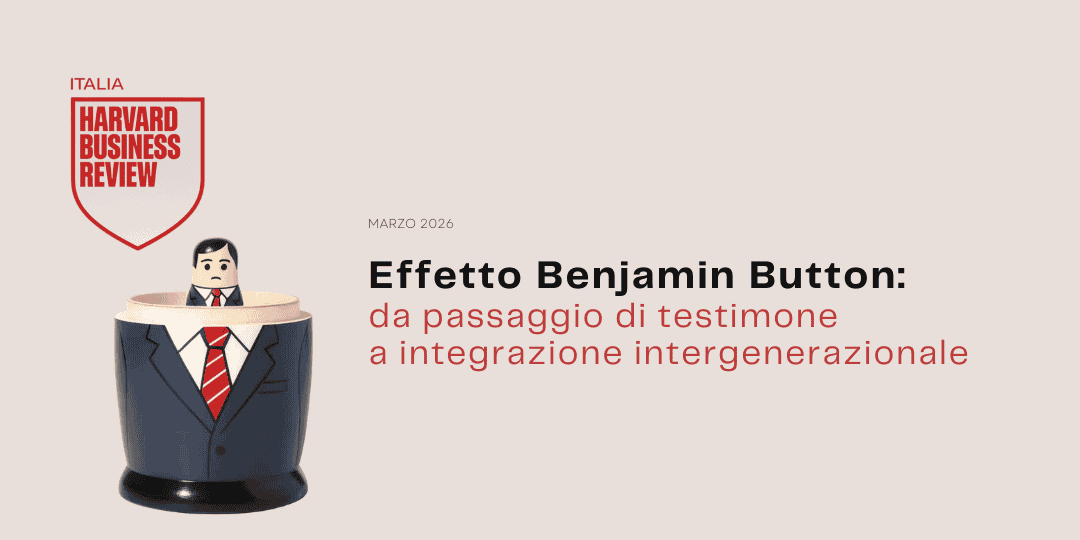
Benjamin Button is the protagonist of a short story by F. Scott Fitzgerald. He is born an old man and, instead of aging, grows younger. He lives out of sync with the expectations of his environment because he is never the “right” age for what he has to offer.
It is within this space that what we call the Benjamin Button Effect takes shape.
In organisational systems, we meet people who are out of sync with expectations: young professionals who bring skills, vision, and the ability to navigate complexity, yet are perceived as “not ready”; seniors who still possess energy, clarity, and execution, yet are gradually phased out because they no longer fit the “right” age.
Generational transition has firmly entered strategic agendas, but it is often addressed through an implicit metaphor: the relay race. The baton passes from one hand to the next, and the person who carried it up to that point stops. It is a powerful image, yet misleading in complex systems.
This mindset creates a system out of sync. Younger generations struggle to take centre stage because they are protected rather than empowered. Seniors feel marginalised, not for a lack of competence, but because the system no longer provides a legitimate space for their contribution.
The result is a loss of belonging, know-how, decision-making quality, and execution.
As management consultants at Hermes Consulting, we have been working for years with financial networks and insurance groups on precisely this issue: transforming generational transition from a matter of age to the creation of a new genealogy.
In a recent initiative with the advisory network of a large financial group, characterised by high seniority and difficulties in attracting and empowering the next generation, we chose to start from the operational conditions of integration.
The first step addressed status and operational recognition. We created structured listening spaces to give visibility to skills, contributions, and often unexpressed concerns. The aim of this work was to reduce friction and defensive attitudes, laying the groundwork for workable cooperation.
The second step focused on clarity of direction and priorities. We facilitated an open conversation on “where we are heading”, translating the vision into a few shared priorities. This improved the quality of decisions and reduced operational ambiguity between management and the network.
The third step reinforced autonomy with accountability. Rather than forcing shadowing arrangements, we defined areas of responsibility aligned with people’s actual skills. Integration was designed as the coexistence of different contributions, underpinned by clear criteria and defined scopes of autonomy.
The fourth step placed system fairness and equity at the centre. We guided management in aligning statements with operational choices, including material ones. This made decisions more transparent and reduced emotional and energy waste across the system.
Only after these steps was it possible to launch intergenerational teams on a voluntary basis and test efficient, effective forms of genuine cooperation. Overcoming the Benjamin Button Effect means moving away from thinking of generational evolution as a relay race, and starting to build a continuity of capabilities.