When the body says something the mind doesn’t know
In a large multinational organisation we support, the executive leadership had launched an organisational transformation project. The aim was to strengthen cross-functional collaboration, reduce vertical hierarchy, and distribute decision-making responsibility. The model had been thoughtfully designed, communicated effectively, and supported by managerial alignment sessions alongside dedicated operational tools.
Months later, however, behaviours remained anchored in the past. Decisions continued to concentrate at the top, collaboration was spoken of rather than lived, and cross-functional roles struggled to gain traction. There was no explicit resistance, but subtle signals were emerging: hesitations before speaking, meetings that were brisk yet ungenerative, protective silences, and a lack of initiative.
The narrative was new, but bodies and relationships were not yet following it.
It is in these moments that we begin to observe the brain at work: not the strategic one, but the deeper brain that interprets context and decides whether to engage or defend itself.
Our work did not begin with new guidelines, but with careful observation of the real dynamics within teams and committees. We listened, decoded, provided debriefs, and then co-designed targeted interventions.
The three brains: what they are and how they shape behaviour
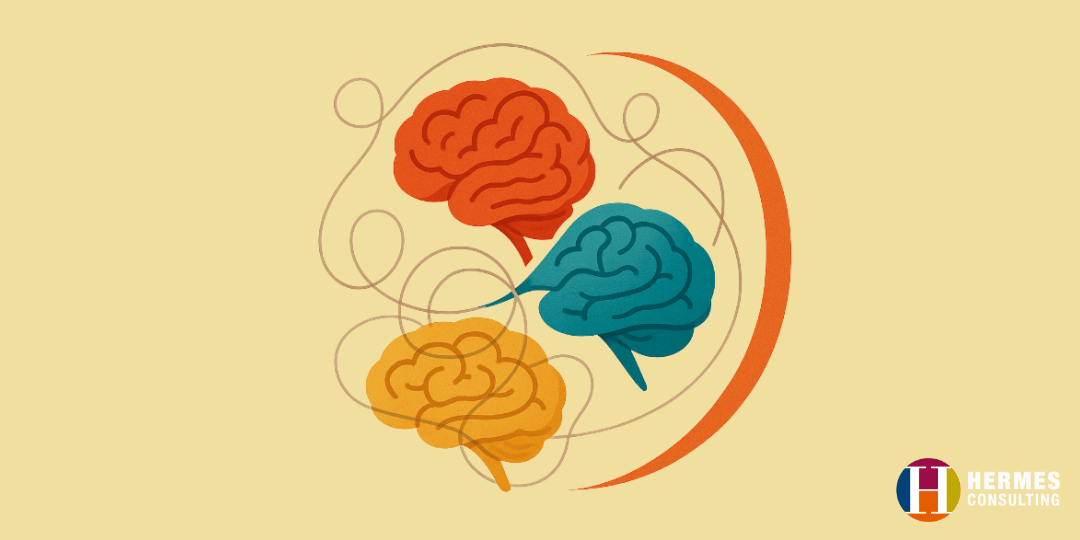
To understand what was happening, we introduced a neuroscience lens that proves valuable in an organisational context: the triune brain model, developed by neuroscientist Paul D. MacLean. Other, more complex frameworks exist, but this theory offers a pragmatic grid for interpreting day-to-day workplace reactions.
We are talking about three distinct systems that coexist within each of us:
What we did
In the project mentioned, we worked alongside the HR department and the steering committee to build a multi-layered intervention. We did not propose traditional “training“, but a progressive journey of observation, awareness, and regulation of behavioural dynamics.
We began with a field listening phase.
Using a variety of techniques, supported by our consultants, we shared a narrative debrief of the observed behaviours with the leaders, outlining concrete, specific patterns.
Next, we facilitated targeted experiential workshops with managers to hone their ability to recognise these patterns, detect the activation of each of the three brains in themselves and others, and adjust their interactions to foster a more relaxed, generative climate.
Finally, we co-created simple, replicable rituals to integrate into everyday routines through a genuine and, above all, shared change process across working groups. We didn’t ask people to do more, but to do better—reading the brain at work with greater nuance at every key moment.
Leading also means regulating
Today, leadership goes beyond decision-making. It also requires the ability to regulate the relational and physiological context in which decisions take place. This does not mean “psychologising” the organisation, but recognising that every individual brings a body that feels, an emotion that interprets, and a mind that reflects. If the first two levels do not feel safe, the third cannot fully engage.
At Hermes Consulting, we guide HR leaders and executive committees on this exact level: we help observe, identify, and transform the conditions that enable change. We work on reading the three brains within organisational settings, design neuro-relational training programmes for managers, and step in during transitional moments with tools tailored to each level, drawing on the specialised expertise of our consultants.
Because sustainable change does not rest on strategy alone, but on the ability to cultivate environments where our brains can truly work. In all their parts.
FIND OUT MORE
Neuroscience and Executive Coaching: how to achieve measurable, sustainable results