The contours of the horizon between agile ways of working and agile leadership
Where are we heading?
Let’s start here:
IN THE MIDST OF AGILE WORKING
We have talked about smart working, remote working and hybrid working. We have witnessed them, experienced them firsthand, and today they have led us to explore new ways of working—far removed from what we were used to, and perhaps closer to a fresh breeze blowing in from outside.
We will soon find out why.
What are we talking about? Today, the new working model is described as “AGILE” and refers to an approach aimed at achieving greater efficiency in delivering organisational goals. It does this by combining flexibility, autonomy and collaboration among people, focusing on the optimisation of tools and technologies, and providing environments best suited to workers’ needs.
Agile working therefore aims to boost company productivity, foster work-life balance and promote greater environmental sustainability.
What are the ingredients of this recipe?
- Work structured around goals, with blurred boundaries.
- Continuous evolution driven by technological advances and the acceleration triggered by the pandemic.
- The development of greater capabilities and higher levels of responsibility across all employees.
- An unstable, ever-changing environment where there is nonetheless a pressing need to invest in preserving tomorrow, making it accessible and thriving for generations to come.
What, then, is the right question to grasp the future of organisational models?
There are two key questions we would like to explore:
- What do leaders see today?
- Are we talking about agile leaders or agile leadership systems?
Several signs point to a major transition.
WANDERERS ABOVE A SEA OF FOG
Let us outline the environment in which the agile leader operates.
Looking at everyday life, the elements that characterise business environments are now intimately familiar. One of these is acceleration.
We are driving down a dirt track and moving fast—so fast that it is difficult to see, and at times we catch only a blur of perpetual motion. Just like being in a racing car winding through the mountains.
When we cannot see clearly, our brain tends to simplify and break things down into parts. It is a mechanism that helps us analyse elements in order to untangle problems. We squint, narrow our field of view, and hope to see a little better.
We attempt to simplify this complexity, to increase control using sophisticated mechanisms, much like tightening our grip when something is slipping through our fingers to stop it falling.
We see very little because movement is fast, and urgency puts us in a position of reacting rather than envisioning.
In today’s landscape, we see a gap between what we have known until now (a structured organisational model, defined by set hours and hierarchical lines) and what we see taking root outside.
On one hand, control; on the other, an ever-expanding space for autonomy, self-determination and the expression of individual identity.
WHAT IS TAKING ROOT OUTSIDE? HYBRID WORKING BETWEEN BOUNDARIES AND HORIZONS
Hybrid working arrived, preceded by the pandemic. Our question is this:
Was hybrid working merely a response to the pandemic, or a sign of cultural evolution and a society searching for something different?
The pandemic most likely accelerated a cultural shift that had been germinating beneath the surface for quite some time.
What happened?
- We learned to coordinate from a distance, working more hours than our attention spans could comfortably sustain.
- Shared responsibility towards common goals grew for many.
- Priorities became clearer.
- Work was shaped around specific purposes for each of us.
Yet there is more to be said when it comes to leadership
For years, people have progressively become true authors of their own paths, capable of self-determination, expressing themselves and discovering their direction.
We have reached the highest levels of schooling and education in history, yet we are witnessing the extraordinary phenomenon of the “Great Resignation”.
What is happening? Perhaps people entering the workplace today arrive armed with dreams and projects. They have a clearer sense of purpose.
The proof? Recently, 400,000 people resigned in the Lombardy region alone to reclaim space for greater self-expression, choosing to pursue paths that felt more personally meaningful.
Their creativity—or rather, their desire to create—is hard to contain, because they are creating all the time: every one of us shares our life and thoughts across countless channels.
We are not willing to compromise on this: we all need to find an organisation that enables us to achieve these aspirations and weaves them into its own.
Perhaps hybrid working is simply the outgrowth of roots far deeper than we might think.
What has it brought that is genuinely new?
We have stepped back a little, and at times we have all stopped seeing, because from home, many things are no longer visible.
To begin with, the physical space is gone, as is everything that space contains. That human intensity held within a workplace can easily dissipate when people rarely go to the office; the team no longer feeds on a shared physical environment, but needs to draw life from something else…
Lived experiences are more meaningful when they are embodied, when we experience them in a tangible setting rather than suspended beside our reflection on a webcam. Neuroscience even tells us that we encode them differently; the hippocampus does not process them in the same way.
Emotions are less intense, the sense of belonging to a community hangs by a thread, shifting its very character.
Cross-pollination—of ideas, energy, emotions and trust—becomes harder. People can easily feel isolated.
Why, then, have some organisations remained cohesive? Why do many still feel a deep commitment to their organisation’s purpose?
Perhaps people today are looking for deeper, more intense and meaningful reasons to place their trust in an organisation.
Belonging to an organisation is now nourished by shared values, goals and purpose.
In a hybrid working world, companies grow and evolve when individual purpose and organisational purpose align for the development of both sides, walking the same road together.
We are living through a cultural transformation where the individual is at the centre, along with self-expression and the desire to contribute to something personally meaningful.
LEADERSHIP AS THE FOG CLEARS
Let us return to our leader.
What emerges once we assemble these pieces of the puzzle?
Let us summarise the key points:
- Visibility is poor, action is fast-paced and movement is constant: envisioning the future is not easy
- We see little of one another and do not share physical space, feeling perhaps less connected to it
- The very meaning of belonging has evolved: it no longer stems from being in a physical location, but from aligning with shared purposes.
- We all aspire to shape projects and build our future by bringing our dreams to life
- Perhaps we need to find a way to bring people together as they step outside that “comfortable container” of heavy control and neatly paved roads
As leaders, what do we do?
AGILE LEADER OR AGILE LEADERSHIP?
What is happening within the business organism?
If we pay attention to what is happening on the ground, organisational systems closely mirror the human body. There is an intricate network of self-organised, more autonomous entities distributed throughout the organism. Every cell can receive and send messages, process them and generate outputs autonomously. If all information produced by every cell had to be centralised in the conscious, thinking brain, the system would quickly grind to a halt, consumed entirely by basic survival.
In the body, authority is naturally distributed because every organ, molecule and cell possesses autonomy and duties to fulfil.
Stepping away from the metaphor: across organisations today, everyone holds a degree of autonomy, carries responsibilities, and delivers tasks from start to finish without requiring continuous external oversight. This is natural and essential to evolution.
Where, then, does the leader fit? Are they truly needed if everyone is autonomous, accountable and guided by a clear purpose?
WE HAVE OUR OWN PERSPECTIVE ON THIS STORY
We believe that leadership works today when the concept of hybridity is closely tied to individual identity and to an employee’s ability to align with an organisation’s values and purpose.
Where personal and collective purpose meet and align, hybrid working moves in the same direction.
We want to speak of leadership of the future—a systemic leadership where, today, the leader is present and necessary, especially in this period of ambiguity. Yet the paradigm of control is no longer what delivers in this great cultural transformation.
We are talking about an intensely human leadership that places people at the centre and knows how to nurture their potential.
The dominant focus today is accountability. It deepens as individual autonomy expands, as what people choose to do aligns with the skills they bring, and above all, as personal and company purpose converge, travelling the journey together.
People want the freedom to work on what inspires them most. At the same time, in the right environment, they can channel their gifts and interests into a broader system they believe in. Driven by genuine passion and interest, individuals become active contributors and creators who believe in what they do and deliver it successfully.
An intensely human leadership appreciates the personal dimension of individuals, while integrating it into the practical and operational dimensions of the organisation.
High-impact leadership is not about acting strictly within the narrow boundaries of a role; rather, it means stepping into the system and being part of it empathetically, operating within fluid boundaries. It listens, facilitates and senses emerging signals to adapt to reality alongside teams.
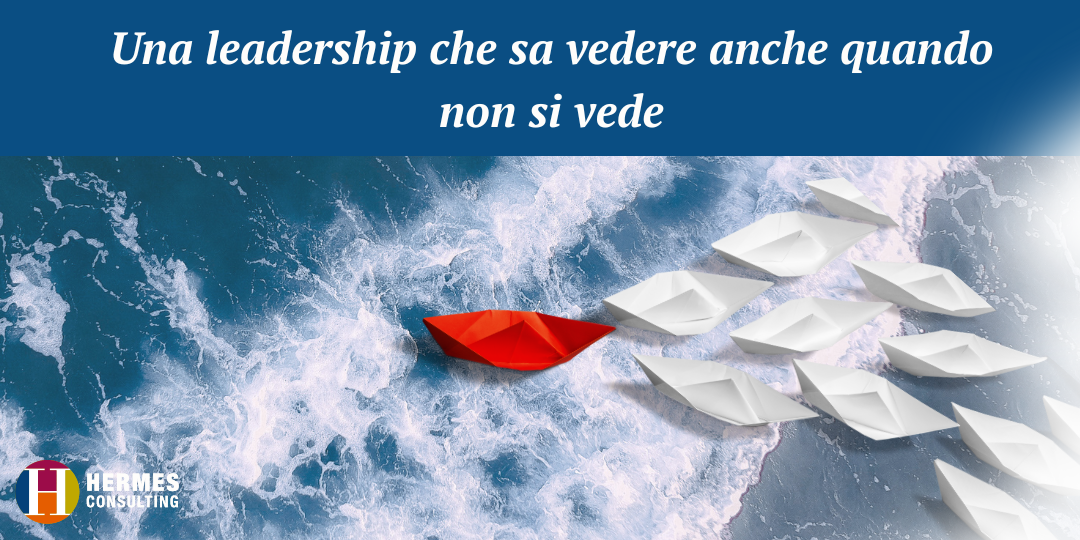
Leaders are essential: they are the ones who can envision and look beyond the fog, planning ahead and projecting themselves past immediate obstacles.
The human brain thrives on clear vision. Neuroscience confirms what we have always known. We move forward because we hold a vivid picture of the horizon in our minds, and when we can see it, we can reach our destination. Today’s leaders are tasked with communicating this vision and helping people discover this landscape.
Picture the weaving of a fine tapestry, rich in intricate patterns and vibrant colours. The leader is the one who takes a thread, untangles it, and guides it towards the canvas, holding a clear picture of the finished piece so it can be placed precisely where it will create the greatest beauty. On one hand, they hold a vision of the whole complexity, keeping and sharing the sense of purpose; on the other, they guide, untangle, and focus on the detail to shape the bigger picture.
We are talking about participative leadership focused on listening, support, development and dialogue—one that nurtures relationships with team members generatively, thrives on daily feedback, and treats the relationship itself as the primary space for action.
Complexity today cannot be eliminated; it must be embraced. Complexity is not complication; rather, it is continuous interaction and exchange.
Its nature is intensely human.